






How to Verify Supplement Purity Yourself at Home

Quick Summary
Supplement purity means confirming that a product contains what its label claims, in the stated amount, and nothing harmful. You can check this at home by reading the supplement facts panel closely, confirming any third-party seal on the certifier's own list, and requesting a batch-specific Certificate of Analysis. A label alone is a manufacturer's statement, not an independent measurement.
- A label is a manufacturer's statement, not an independent measurement of contents.
- Proprietary blends with no individual amounts leave you unable to judge the key ingredient's dose.
- Check that a seal appears on the certifier's own published list for the exact product and strength.
- A Certificate of Analysis must match your lot number to show results for your actual batch.
- Use FDA recall and CAERS databases to check whether a product or ingredient has been flagged.
Table of Contents
- How to Verify Supplement Purity Yourself at Home
- Why Supplement Purity Is Hard to Confirm From the Label Alone
- How to Read a Supplement Label for Quality
- Third-Party Supplement Testing: What the Seals Actually Cover
- Using the NSF and USP Verified Supplements List
- How to Request and Read a Certificate of Analysis
- Checking Supplements for Contaminants, Adulteration and Reports of Harm
- Choosing Your Next Supplement With Confidence at Nourishing World
- Frequently Asked Questions
How to Verify Supplement Purity Yourself at Home
Last Updated: November 19, 2026
Why Supplement Purity Is Hard to Confirm From the Label Alone
Most people assume a supplement bottle tells them what is inside it. Usually it does, but only in part.
The core problem is that a label is a manufacturer's statement, not an independent measurement.
Research on multi-ingredient supplements points to the same difficulty. A 2025 study in the Journal of Dietary Supplements on analytical methods found that quality control for these products is genuinely hard, because many active ingredients must be measured at once.
So the practical goal is not to become a laboratory. It is to learn which signals on a label are meaningful, which are vague, and how to find evidence that goes beyond the packaging.
How to Read a Supplement Label for Quality
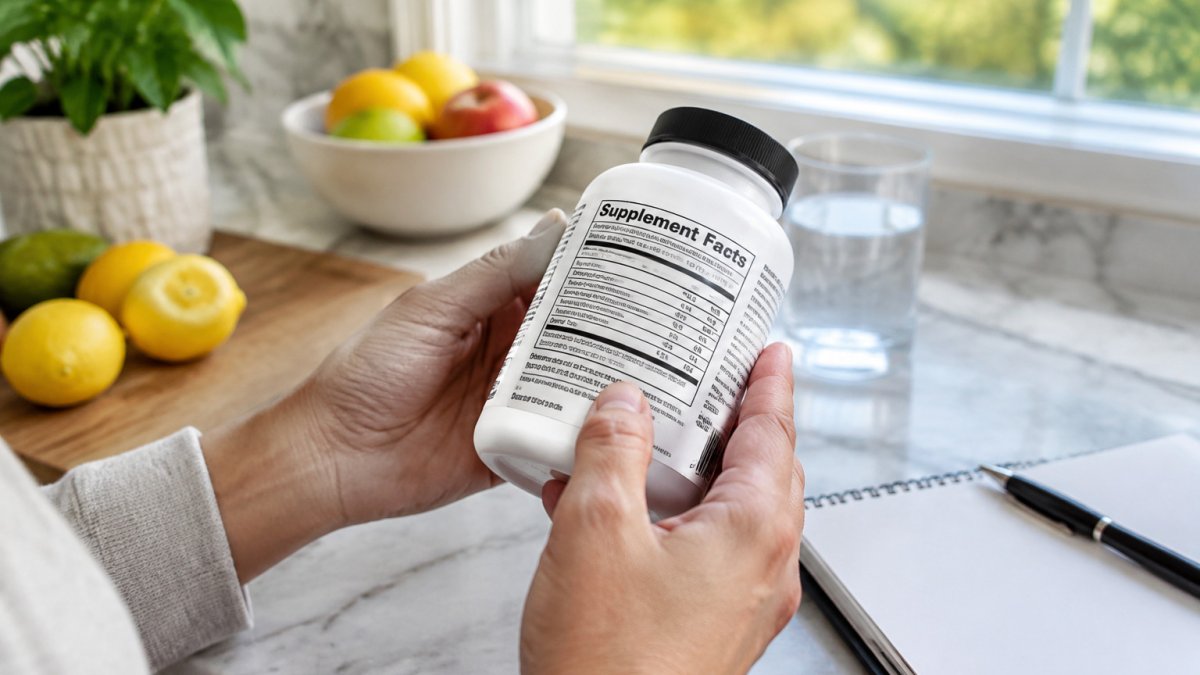
A quality label is specific. It names the ingredient, the form, the amount per serving, and the serving size. Start by reading the supplement facts panel, then look at how the ingredients are described, and finally check whether the product carries any outside verification.
Checking the Supplement Facts Panel
The supplement facts panel is the most useful part of the label, because it commits the manufacturer to specific numbers. Look for:
- The exact amount per serving for each active ingredient, with a unit such as mg, mcg or IU.
- The ingredient form, for example magnesium glycinate rather than just "magnesium."
- The serving size and servings per container, so you can calculate the true daily dose.
- Percent Daily Value, where it applies, for context on nutrient levels.
When a panel lists a proprietary blend with a total weight but no breakdown of each ingredient, treat that as a gap. You cannot tell whether a meaningful dose of the key ingredient is present. Ask the manufacturer for the individual amounts before you buy.
Spotting Vague Ingredient Claims
Some labels use wording that sounds reassuring but says very little. Phrases such as "clinically inspired," "supports wellness" or "full spectrum" are not measurements. Be cautious with any claim that cannot be checked against a number, a named standard or a testing body.
A common mistake is treating a long ingredient list as a sign of quality. More ingredients can mean more opportunities for inconsistency, and what matters is whether each one is listed clearly with an amount.
The supplement facts panel is the most useful part of the label because it commits the manufacturer to specific numbers. Look for these items:
| Label item | What to look for | Red flag |
|---|---|---|
| Amount per serving | Exact amount with unit such as mg, mcg or IU | No amount listed |
| Ingredient form | Named form, e.g. magnesium glycinate | Only the general nutrient name |
| Serving size | Serving size and servings per container | Missing, so daily dose cannot be calculated |
| Proprietary blend | Individual amount for each ingredient | Only a total blend weight |
| Percent Daily Value | Shown where it applies, for context | Used in place of an actual amount |
Third-Party Supplement Testing: What the Seals Actually Cover
Independent seals are one of the strongest signals available to a shopper, but they are not identical. Different programs test different things, so a seal is only as meaningful as the checks behind it.
NSF's dietary supplement certification states that it tests products in its own accredited laboratories and compares actual contents with label claims. USP describes its verification as rigorous testing and auditing. Both are useful, but the available information does not show that every seal covers the same checks, such as contaminant screening, manufacturing audits or ongoing batch testing.
When you see a seal, ask three questions:
- Which organization issued it, and is it independent of the brand?
- Does the seal apply to this specific product, or only to the company or a different formulation?
- Does the program test label accuracy, contaminants, or both?
If the answers are unclear, the seal tells you less than it appears to.
Using the NSF and USP Verified Supplements List
Rather than trusting a logo alone, check the certifying organization's own published list. Both NSF and USP maintain searchable databases of products that have passed their programs. This takes a few minutes and avoids being misled by a seal that has been copied or applied to a different product.
To use these lists well:
- Search by the exact product name and the manufacturer, not just the brand.
- Confirm the formulation, strength and flavor match the bottle you are considering, since a certification can cover one version only.
- Note the date on the listing, because certification status can change.
A product that appears on a verified list has been checked against a published standard. A product that merely claims to be "verified" without appearing there deserves skepticism.
How to Request and Read a Certificate of Analysis
A Certificate of Analysis, or COA, is a batch-specific test report. It shows what was measured in a particular production run, which makes it more informative than a general quality claim.
Work through a COA in this order:
- Confirm the batch or lot number on the COA matches the number printed on your product. A COA without a lot number is a generic spec sheet, not a batch record.
- Check the test date to make sure the results are reasonably recent and fall within the product's shelf life.
- Compare the measured potency against the amount on the label. Results close to the label claim are what you want to see; a result far below claim is a red flag.
- Look at the contaminant results, including heavy metals, microbial counts, and residual solvents, and confirm each has a stated limit and a pass or fail result.
- Identify the testing laboratory and check whether it is independent of the manufacturer and accredited (for example, to ISO/IEC 17025).
Some COAs are self-generated by the manufacturer, and some come from an outside lab. An independent, accredited lab report carries more weight. If a company cannot or will not provide a COA for its product, that is itself useful information.
Using Digital Tools to Cross-Reference a Batch
Most guides stop at the paper COA. The more useful step is to verify the batch digitally, because a PDF can be copied, edited, or reused across lots. Three checks take a few minutes:
- Search the certifier's own database. If the bottle carries an NSF Certified for Sport or USP Verified mark, look up the exact product name, strength, and flavor on the certifier's published list. Certification can cover one formulation only, so a match on the brand is not a match on the product.
- Use the manufacturer's lot-lookup portal. Where a brand publishes a batch search, you can enter the lot code and see the COA for that run. If the portal returns a different product or a date outside the expected window, treat the bottle as unverified.
- Cross-check the lab. Look up the testing laboratory named on the COA and confirm it is accredited and independent. A lab that shares an address or ownership with the manufacturer is not an independent check.
Watch out: a QR code on the label that leads to a brand marketing page is not the same as a lot-level COA, and a COA that lists only "identity confirmed" without potency and contaminant results does not answer the purity question.
If you cannot find a batch record anywhere, ask the manufacturer directly for the COA tied to your lot number. A company that responds with a specific document is a better signal than one that replies with a general quality statement.
Checking Supplements for Contaminants, Adulteration and Reports of Harm
Purity also means the absence of things that should not be there.
Start with the manufacturer's published testing information. A credible contaminant panel will name the test method and the limit used.
Adulteration is the hardest category to see from a label. It is most common in products marketed for energy, weight loss, sexual health, and bodybuilding, where undeclared stimulants, diuretics, or prescription analogs have been found in independent screens.
Watch out: a clean COA for one batch does not guarantee the next batch, because contaminant results are lot-specific and botanical raw materials vary by harvest.
How to Check Recalls and Adverse Event Reports
Regulatory databases are the fastest way to see whether a product or ingredient has already been flagged.
If you suspect a product caused a reaction, you can file a report yourself through the FDA's MedWatch program or the CAERS consumer reporting portal. You do not need proof, and you do not need to be a healthcare professional.
Keep in mind that a single report does not prove a product is unsafe, and an absence of reports does not prove it is safe. Look at the pattern of evidence, the quality of the testing behind a product, and whether the manufacturer publishes batch-level results rather than a one-time certificate.
Choosing Your Next Supplement With Confidence at Nourishing World
Verifying purity takes effort, but the steps above give you a reliable routine: read the supplement facts panel closely, treat vague claims with caution, check that any seal appears on the certifier's own list, and request a batch-specific COA when the product warrants it. Browse current clean-label options that have been vetted once you are ready to compare them.
At Nourishing World, we select products for clean labels, pure ingredients and sustainable sourcing, and our staff are trained on the products they stock and sell. Before you buy from any shop, including ours, check the return policy, the shipping practices and how long the business has operated.
For a clear next step, start with a product that has a verifiable seal and a published batch report, then build from there. Browse our selection, compare the labels using the checklist above, and choose the supplement whose evidence you can trust.
Frequently Asked Questions
How do I check the purity of supplements at home?
Start with the label. Look for a full supplement facts panel that lists each active ingredient with its amount, and avoid products with proprietary blends that hide doses. Next, check whether the product carries a third-party seal from an independent program such as USP or NSF, then confirm that seal on the certifier's own verified product list. For a closer look, ask the brand for a certificate of analysis for the specific batch you are buying.
Is there a website I can use to verify supplement quality?
Yes. The USP Dietary Supplement Verification Program and NSF both publish searchable lists of products that have passed their testing and audits. Search for the exact product name and manufacturer, because a certified brand does not mean every product in its line is certified. Note that the search results used for this guide do not establish that these programs have identical scopes, so read each program's own description of what it tests before relying on it.
What does a USP Verified or NSF mark actually mean for consumers?
A third-party mark means an independent organization reviewed the product. Both programs are independent third-party certifiers, and their scopes differ. Neither mark guarantees that a supplement works for you, and the programs do not check every possible contaminant. Treat the mark as one strong signal among several, alongside label accuracy and the manufacturer's sourcing practices.
How do I know if a supplement label is accurate?
Compare the label against independent verification where available, and against a batch-specific certificate of analysis where the brand provides one. Check that ingredient amounts are stated as quantities rather than vague terms, and that the product name matches what is in the bottle. Unexplained proprietary blends and missing batch or lot numbers are common reasons to question a label. At Nourishing World, staff are fully trained on the products they stock and sell.
